Feeds:
Posts
Comments

Posts Tagged ‘Product Trends’

An interesting by-product of the economic meltdown that our country is living through is the shifting of priorities that is slowly – and surprisingly – becoming evident.  Yes, we have all adopted the “recessionista / frugalista” code of conduct whereby we pledge not to spend on unnecessary items for ourselves.   However, consumers are demonstrating a willingness to spend, if it is “for a greater good”.

50% of profits go to help African women & children affected by AIDS

50% of profits go to help African women & children affected by AIDS

On a personal note, I was recently the chairperson of a fund-raising event to benefit a foundation for a specific life-threatening illness.  Although I had already set a fund-raising goal for this year’s event based on the donations raised at the same event last year, I had already prepared myself mentally to be content if we so much as reached last year’s goal.  In my mind, there was very little chance that people would be overly generous this year, with all the financial turmoil that people were experiencing.    To my surprise, not only did we meet this year’s seemingly impossible goal, but we surpassed it by a substantial amount!   

Bringing relief to disaster victims

Bringing relief to disaster victims


Consumer products with tie-ins to charitable foundations that benefit worthy causes are evidently performing well.  And CPG companies are taking notice!  P&G’s yellow-label Tide will be available for a limited time only, but under its Loads of Hope initiative, is committed to contributing 10% of its sales to families affected by disasters.   In the meantime, Loads of Hope teams visit affected areas and do laundry for citizens who have been displaced by events that have affected their region. 
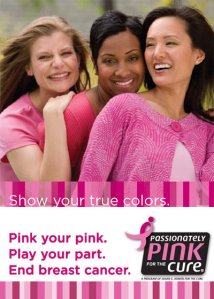
Shop pink & help end breast cancer

Shop pink & help end breast cancer


Other similary civic-minded and high profile “retail” campaigns are the “Pink for the Cure” items sold whereby a portion of sales benefits breast cancer research, as well as Gap’s “(PRODUCT) RED” campaign where half the profits from product sales go to the Global Fund and benefit women and children in Africa affected with AIDS.


So next time you’re looking for a fragrance, shampoo, body wash or lotion seek out those whose sale will benefit a greater good, and get double the enjoyment from your purchase!

Read Full Post »

Although the 18-39 demographic has always been the most pursued by marketers, baby boomers – those born between 1946 and 1964  – are a consumer group 78 million strong to whom advertisers are now paying more attention.Jane Fonda for L'Oreal

The older boomers are now approaching 63 years; an age at which many have fully paid off their mortgages, are now enjoying grand parenthood, and are more willing & able to spend money on their grandchildren and themselves.  This makes them doubly attractive to marketers because they are making purchases for more than one demographic group; i.e., they are just as likely to buy baby & children’s products as they are to buy travel services, or anti-aging skin care products. 


Companies such as Target, P&G, Kraft & L’Oreal are taking notice and increasingly targeting this age group:

Target's Aged in Advertising

 Boomers Life

Fifty today is very different than it was in the past.   Boomers today are vibrant, active and “plugged in”, comfortably embracing the digital information age; exactly what you want in a “dream consumer”!

Although in the past there was much debate about whether a “one size fits all” marketing approach effectively targeted consumers of all ages and lifestages, it has become more apparent that marketers are realizing the importance of customizing their messages to make a product truly relevant to a particular consumer group. 

Bearing this in mind, if the fragrance world were to follow in the footsteps of other product categories – say anti-aging skin care – some relevant messages (and fragrance positioning statements) that would appeal to the maturing consumer would be:  pampering, nourishing, luxurious, glowing, smoothing, firming, caring; attributes that can be creatively interpreted in fragrance notes that convey those characteristics.   Soft florals, light woods and creaminess effectively convey pampering & nourishing qualities, while fruity and botanical notes help connote a glowing and wellness aspect.  Tweaking of the notes can further enhance either the luxurious or caring aspects of a scent, depending on which fragrance ingredients are highlighted.

As I’ve stated before, fragrance is a breathing, living and continuously evolving art in which anything is possible.  All it takes is a little bit of imagination, creativity…and masterful perfumery!

Read Full Post »

The advertising industry is banking on nostalgia themes to get consumers out of their spending slump. 

Consumer good giants are reaching back into their archives and reintroducing earlier jingles or packaging designs used for their products in earlier decades, in hopes that consumers’ nostalgia about the past will help fuel some  optimism about life today.

Pepsi Throwback and Mountain Dew ThrowbackPepsi Cola and Mountain Dew have reintroduced “throwback versions” of their popular sodas that are evocative of the ’60s and ’70s, and sweetened with real sugar instead of with high fructose corn syrup.  Meanwhile, Diet Coke has gone back to its 1982 tag line, “Just for the taste of it”.              

Cotton Inc’s. 1981 advertising campaign reassured us that “The touch, the feel of cotton”  was “The fabric of our lives”; a theme that is revisited in 2009, as they pursue a marketing strategy of going back “to the brand’s rich heritage”.   View campaign at: http://www.thefabricofourlives.com.              Source:  Marketing Daily 4/22/09.

General Mills cereals are also being sold in throwback boxes at select Target stores, while I Can’t Believe It’s Not Butter launches a new campaign with a 1950’s visual style, but with a very contemporary message about current health & nutrition trends.   

The Buttertons

The Buttertons

Trix: Retro and Current 

Watch The Buttertons’ transformation from 1950’s cheeky to 2009 hip & healthy by clicking on the link to the left.  


 Woman enjoying music, listening to old-fashioned record playerIn fragrance, nostalgia themes are interpreted with gourmand notes such as vanilla & chocolate, popular for their intrinsic feel-good qualities.  Soft woods, musk and nutty notes also wrap you in their sweet, warm and creamy comfort. 

Expect to see many of these nostalgic notes incorporated into the green fresh floral and botanical fragrance characters that have been the common denominator in recent scent development as consumers look for an antidote to life’s uncertainties and stresses!

Have a fragrance or product category you’d like to read more about?…Send me a note and you’ll find it in a future post!

Read Full Post »

Sometimes too much of a good thing just…isn’t! 

Food manufacturers are realizing that long ingredient lists that read like chemical formulas with unpronounceable names do not communicate the “healthy-eating” message that prevails in today’s lifestyle. 

On a previous post, I talked about how fragrance trends are evolving to become more authentic and simplified without losing their scent integrity.   This is being achieved with fewer – but higher quality –  ingredients that are being used in the newer scent interpretations to convey a more authentic, natural feeling where ingredient provenance and sustainability were also key points for the scent’s marketability.

In the food industry, a similar shift is being seen.  Frito Lay redesigned its potato chips and Tostitos packages to connect their products back to their agricultural origins – that is, potatoes and corn – while informing us that they are made with just three ingredients.  Snapple’s reformulated beverage line reminds us that “the best stuff on earth” is made with green and black tea leaves and “real” sugar.  Haagen-Dazs’ new Five ice cream line assures consumers that its ice cream flavors only contain five ingredients:  skim milk, cream, sugar, egg yolks and (flavor).   This is the antithesis of the highly processed foods that have come under greater scrutiny after recent product recalls following the waves of people across the nation who became ill from poorly-processed items.

The message of simplicity works in a two-fold manner.  It is suggestive of something that is simple enough to be homemade, therefore “authentic”.  But its appeal is especially significant  because we are now living through one of the most tumultuous economic times resulting from our past excesses, and we are all poised to go back to basics.   Right now, simple sounds…a lot better!

Read Full Post »